Overview
City of Design - Saint-Étienne
Front-end Development for a High-Visibility Cultural Platform
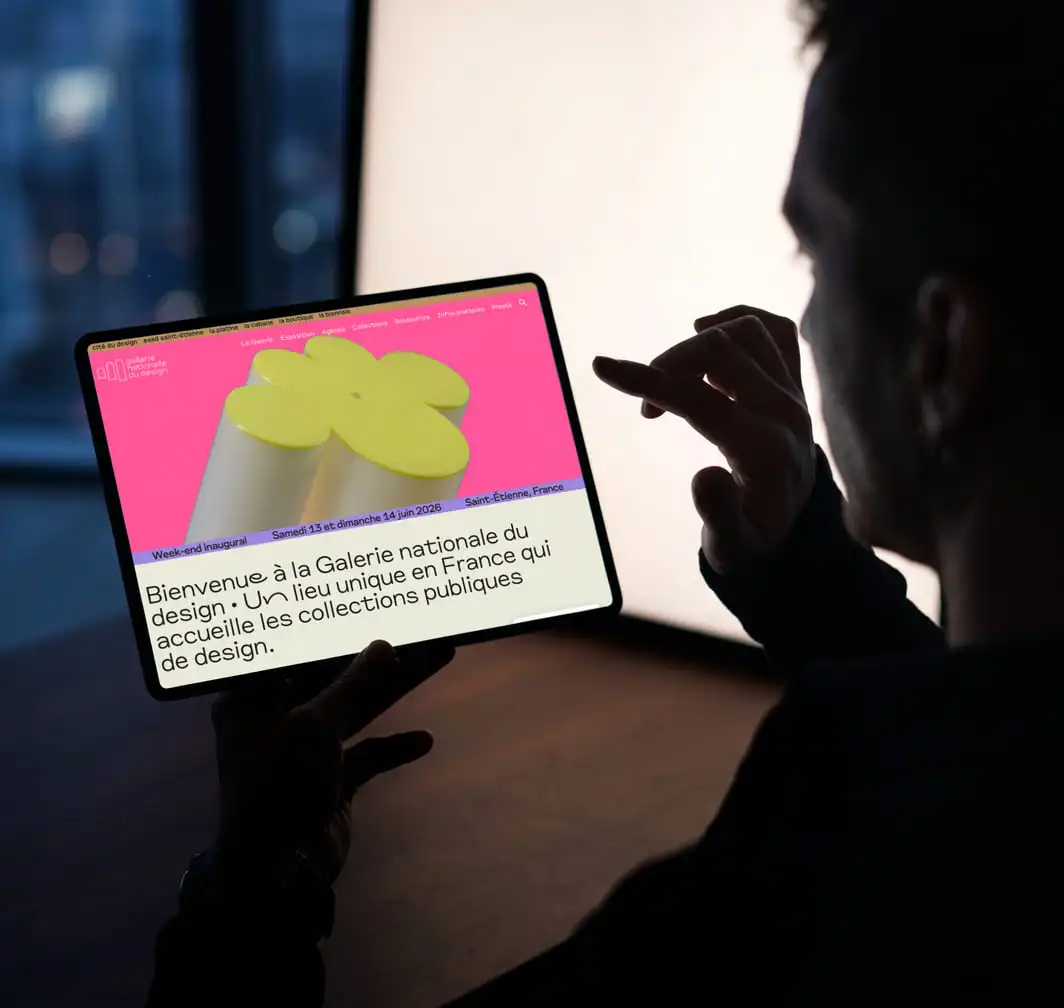
The National Design Gallery website was a challenging project that combined a tight deadline, ambitious design requirements, and high technical expectations. Built to support the public launch of a major cultural institution, the platform required a strong focus on performance, sustainability, and pixel-perfect implementation.
Context
The National Design Gallery was created to showcase and promote France’s public design collections through a modern digital experience.
As the website was scheduled to go live alongside the institution’s official launch, it was expected to receive significant traffic from day one. Ensuring reliability, speed, and a seamless user experience was therefore a critical part of the project.
Challenges
Advanced Typography Integration
The visual identity relied heavily on custom typography, including multiple font variants and specific glyph management requirements.
Special attention was given to:
Integrating custom typefaces and font assets.
Handling specific glyph sets and typographic behaviors.
Optimizing font loading strategies.
Maintaining visual consistency across devices and browsers.
The challenge was to preserve the intended artistic direction while keeping the website lightweight and performant.
Performance at Scale
Because the platform was expected to attract a large audience during its launch period, performance was considered a core requirement from the start.
Key areas of focus included:
Asset optimization.
Efficient rendering strategies.
Progressive loading techniques.
Minimizing third-party dependencies.
Improving Core Web Vitals metrics.
Every technical decision was made with scalability and responsiveness in mind.
Sustainable Web Development
Eco-design is a fundamental part of our development approach, and this project was no exception.
To reduce the website’s environmental footprint, we focused on:
Building a lightweight front-end architecture.
Limiting unnecessary JavaScript.
Optimizing media delivery and resource loading.
Reducing the overall cost of each user interaction.
This approach helped balance visual quality with digital sustainability.
Development Process
The entire front-end was developed by a team of two developers.
Rather than relying on pre-built UI libraries, we designed and built every component from scratch to meet the project's specific requirements. This included:
Custom UI components.
Flexible layout systems.
Optimized animations and interactions.
High-fidelity implementation of the design system.
Building everything in-house gave us complete control over performance, maintainability, and user experience.
Outcome
Despite a very compressed production timeline, the project was successfully delivered on schedule.
The final result is a fast, scalable, and visually refined platform that combines:
Strong performance.
Precise design execution.
A fully custom front-end architecture.
Sustainable development principles.
This project demonstrates our ability to deliver high-quality digital experiences under demanding constraints while maintaining a strong focus on performance, craftsmanship, and eco-conscious development.